
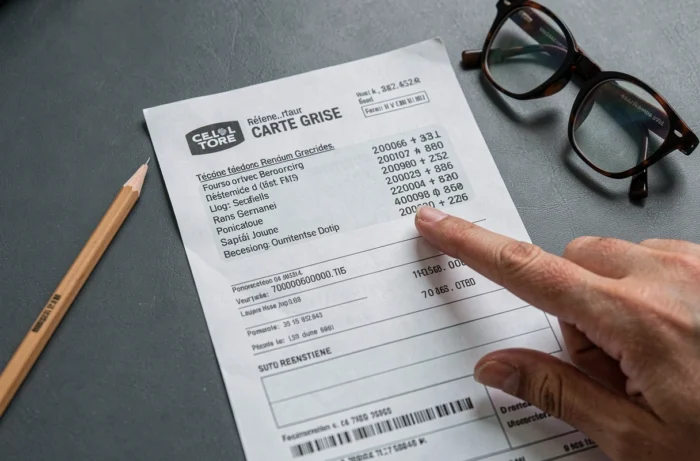
The vehicle registration document lists dozens of technical details, from the type of fuel to the fiscal horsepower. The color is also included, but in a form that often leads to confusion. This distinction has direct consequences when it comes to ordering a touch-up or repainting a body part.
Color on the registration document: what it really indicates
The administration retains a limited palette of standardized names: white, black, gray, red, blue, green, beige, brown. These names each cover several dozen different shades from manufacturers.
A vehicle registered as “gray” can be painted in a pearlescent light gray, a matte anthracite gray, or a metallic bluish gray. The color mention on the registration document does not allow for ordering paint. It identifies the vehicle for law enforcement and administrative procedures, not for a body shop.
Two other boxes on the registration document are of practical interest for finding the paint code. Box E contains the VIN (Vehicle Identification Number), and box A contains the registration number. This data, transmitted to the manufacturer or a specialized online service, can sometimes trace back to the exact reference of the original paint. You can consult the advice on Car System to understand how to read these different sections.

Manufacturer paint code and RAL reference: two systems not to be confused
A common mistake is to look for a vehicle’s color in the RAL color chart, a standardized standard used in industry and construction. RAL 9010, for example, corresponds to a generic “pure white.”
Automakers use their own coding systems. Renault assigns codes like D69, Peugeot uses references like EWP or EZR, and Ford has its own alphanumeric series. A RAL code never replaces a manufacturer reference for automotive touch-ups. The chemical composition of the paint, its finish (matte, pearlescent, metallic), and its pigments are calibrated to the reference specific to the model and year of production.
Ordering automotive paint based on an approximate RAL often leads to a visible color mismatch, especially in natural light. The commercial name of the color poses the same problem: two shades bearing the same name, like “Nardo Gray,” may correspond to different formulas depending on the year or manufacturer.
Manufacturer plate: where to look for the paint code on the vehicle
The exact paint code is found on a plate or sticker affixed by the manufacturer to the body or structure of the vehicle. Its location varies from one brand to another, complicating the search for an owner unfamiliar with their model.
The most common locations are:
- The driver’s side door pillar (Renault, Peugeot, Citroën on many models)
- The engine compartment, often on the front crossmember or hood support (Ford, certain Volkswagen series)
- The inside of the trunk or the fuel flap (Smart, certain Asian models)
- The passenger side door pillar, less common but used by some manufacturers
No single location covers all brands. A guide that recommends checking only the driver’s door misses the majority of cases. The plate generally mentions several pieces of information: the paint code (sometimes preceded by the mention “color” or “paint”), the VIN, and other technical references.
When the plate is unreadable or missing
On older vehicles or those that have undergone body repairs, the plate may be worn, covered in paint, or simply missing. In this case, the VIN remains the best starting point. Transmitted to the manufacturer or a car paint distributor, it allows for finding the factory shade associated with the vehicle.
Some online services offer to find the paint code based on the VIN or registration number. Field reports vary on the reliability of these tools depending on the brands and production years. A dealer of the brand remains the most reliable source when all other avenues fail.
Bodywork touch-up: why the exact code changes the result
A touch-up done with paint slightly different from the original is noticeable, even on a small surface. Daylight reveals color discrepancies that artificial lighting in a garage can easily mask.
The aging of the original paint further complicates matching. A vehicle exposed to UVs for several years shows a shade that has evolved compared to the factory paint. The manufacturer code provides the original shade, not the current shade of the vehicle. Professional bodyworkers use spectrophotometers to measure the actual color of the body and adjust the formula accordingly.
For a superficial scratch, a touch-up pen ordered with the correct manufacturer code is usually sufficient. For an entire part (fender, hood, bumper), consulting a professional equipped with a color measurement tool limits the risk of visible mismatch between the new part and the rest of the body.
The registration document guides the search but does not provide the final answer. The registration certificate provides the VIN and registration number, two keys to access the manufacturer code. Physical verification on the vehicle’s plate remains the most direct method, provided you know where to look according to the brand.