A rainy afternoon, a stretching Wednesday, an end of the day where energy overflows: finding activities to entertain your children on a daily basis can sometimes be a challenge. There is no shortage of lists of crafts and motor games online, but they often overlook a powerful lever: the environment in which the child evolves and the space we give to their initiative.
Free play at home: why letting the child get bored changes everything
You may have noticed that a child left alone with three pieces of cardboard ends up building a spaceship? It’s not a coincidence. Free play, where the adult imposes neither rules nor objectives, develops autonomy in a way that directed activities cannot replace.
A study published in 2025 in Revista InveCom observed, in a small group of 5-year-old children, a progression in autonomy after an intervention based on free play. The principle is simple: provide a variety of materials (cushions, fabrics, kitchen utensils, boxes) and step back.
The child fumbles, invents, fails, and tries again. It is in this fumbling that patience and creativity are built. Boredom, far from being a problem, becomes the trigger. Instead of filling every minute with a schedule, we reserve blocks of time without planned activities.
Resources like pcommeplimplim.com offer materials and environments designed to nurture this type of autonomous exploration in young children.
Arranging the indoor space to stimulate children’s creativity
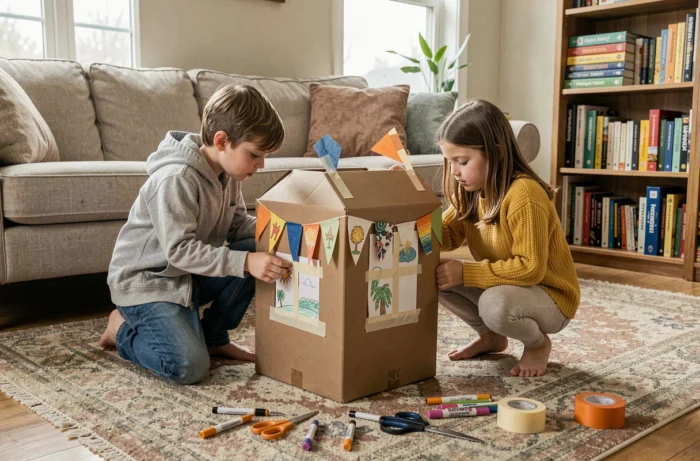
Before looking for the next fun activity to propose, take a look at the room where your child plays. The arrangement is as important as the activity itself. A space cluttered with toys that are permanently accessible often produces the opposite effect of what is hoped: the child flits around, not settling on anything.
The principle of rotating materials
Store away most of the toys and leave only four or five accessible at a time. Every two weeks, rotate them. The forgotten toy becomes new again, curiosity is reignited without buying anything.
Simple thematic corners to create
No need to turn the living room into a classroom. A few markers are enough:
- A “creative leisure” corner with sheets, crayons, modeling clay, and a roll of kraft paper fixed to the wall at child height.
- A “fort” corner with a sheet stretched between two chairs, cushions, and a flashlight. This refuge becomes a library, cave, or restaurant in turn.
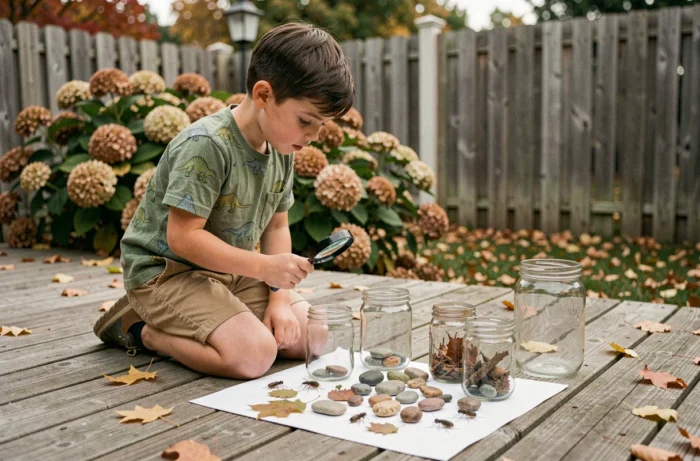
- An “exploration” corner with a magnifying glass, shells, seeds, and a small notebook to draw observations. This works particularly well for children aged 4 or 5 and up.
The idea is not to multiply corners, but to make the materials visible and accessible without adult help. A child who has to ask for permission for each object loses the momentum of spontaneous play.
Sensorial and creative activities with everyday materials
The most engaging activities for children do not require a significant leisure budget. Water, flour, rice, shaving cream: the materials are already in your cupboards.
Foam painting
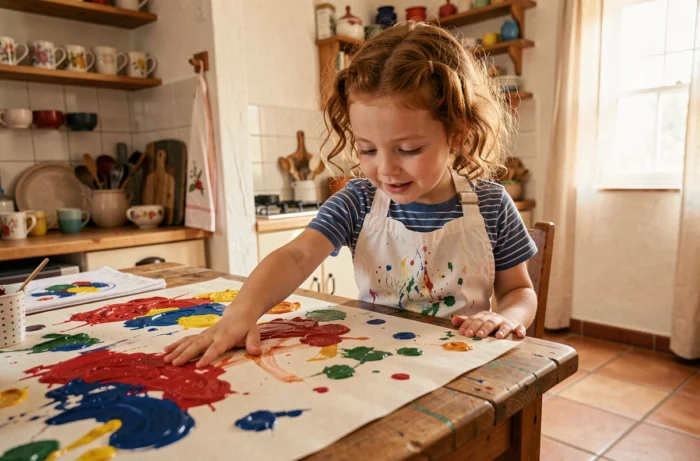
Mix shaving cream with a few drops of paint. The child spreads, traces, and mixes colors directly with their hands. This activity works on fine motor skills while providing immediate sensory pleasure. Plan for a tarp or an old sheet on the floor to limit mess.
Sensory bins
A large bin filled with colored rice (colored with vinegar and food coloring, then dried) in which small objects are hidden. The child digs, sorts, and transfers with spoons, cups, and a funnel. For older children, hide letters or numbers to find: the bin becomes an educational treasure hunt game.
Ephemeral constructions
Collect toilet paper rolls, bottle caps, and packaging cardboard. Provide glue and tape. The only instruction: build the tallest tower possible, or a bridge that can support a small car. This type of challenge appeals to both 4-year-olds and 9-year-olds, adjusting the complexity accordingly.
Screens and children: setting a framework without guilt
Fun activities make sense when we think of them as concrete alternatives, not as a punishment replacing a confiscated screen. The report from the expert commission submitted to the presidency of the Republic on April 30, 2024, recommends no screen before age 3 and discouraged or exceptional use until age 6.
After this age, the High Council of Public Health does not set a universal hourly threshold. It favors an approach that takes into account what the screen replaces: sleep, physical activity, play, or social interactions. The question to ask is not “how many minutes?”, but “what is my child not doing during that time?”.
Offering an attractive alternative works better than a strict prohibition. A sensory bin ready on the table, a construction challenge set at snack time, a fort corner set up: the child naturally chooses the activity when the environment invites them to do so.
- Before age 3: prioritize manipulation games, board books, and moments of free play on the floor.
- Between ages 3 and 6: alternate creative activities, outdoor outings, and quiet time without digital support.
- After age 6: involve the child in choosing their activities and define screen time together.
Entertaining your children on a daily basis does not require a timed schedule or a catalog of sophisticated crafts. A well-thought-out space, simple materials in free access, and blocks of free play are enough to nourish their curiosity. The rest, they invent.