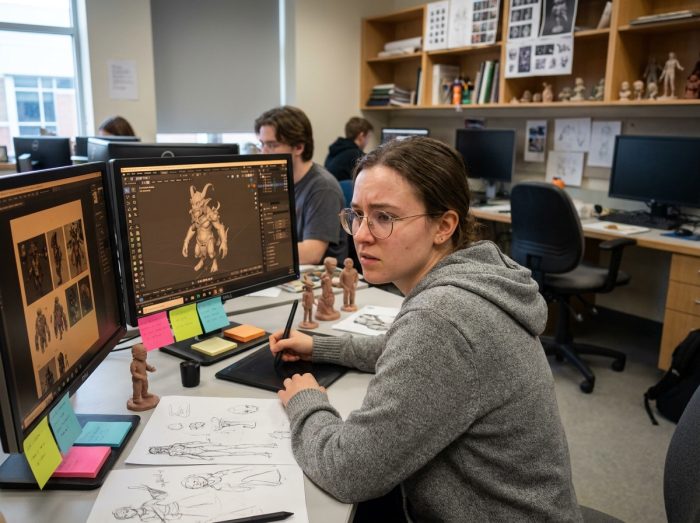
A render crashing at three in the morning, a character rig that refuses to bend the elbow correctly, a scene needing to be reworked because the lighting flattens all the volumes: this is what defines the weeks in 3D animation training. Far from the spectacular trailers broadcast by schools, the daily life of 3D animation students is based on repetitive technical constraints and a constant learning process through mistakes.
3D Rendering and Project Management: The Dual Burden That Structures Every Week
It is often imagined that 3D creation boils down to manipulating characters on a screen. In practice, a considerable amount of time is consumed by the technical management of the production pipeline. Each student project requires juggling between modeling, texturing, rigging, animation, lighting, and rendering, all under tight deadlines.
The most frequent point of friction remains the calculation time. A poorly optimized scene can block a workstation for hours. When working in a team of four or five on a short film, a single corrupted file can delay the entire production chain. Students quickly learn to version their files and to schedule renders outside of class hours.
To concretely understand the daily life of 3D animation students, one must accept that the artistic dimension represents only part of the workload. Project management, team meetings, and technical decisions often take up as much space as drawing or animation itself.
Proprietary Software and Cloud: The Hardware Constraints in Animation Training
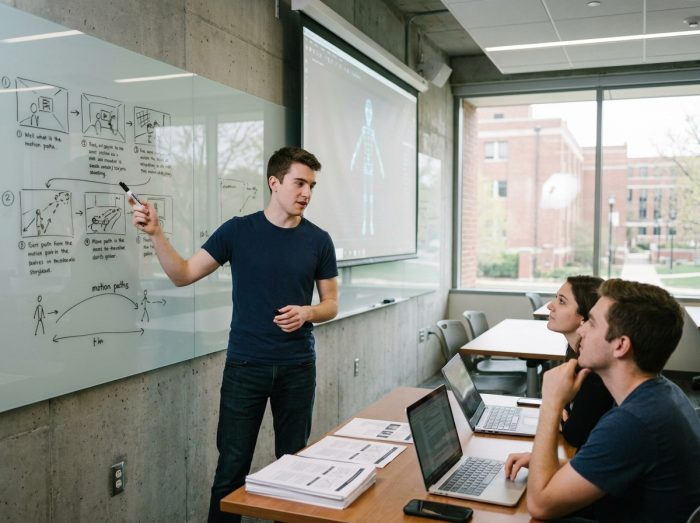
Maya, Houdini, ZBrush, Nuke: the software stack of a 3D animation student demands powerful machines. However, several schools have gradually migrated to cloud computing solutions to reduce equipment costs. Testimonials from students at Gobelins and Rubika report recurring frustrations related to network latencies, especially during rendering or particle simulation phases.
This shift to the cloud has a concrete effect on the work pace. When the connection falters or the server saturates during peak times, rendering times can triple. Some students end up investing in their own equipment to avoid depending on the school’s infrastructure.
The Hidden Cost of Software Licenses
Schools generally provide educational licenses. But as soon as one wants to work freelance or on a personal project concurrently, the prices of professional licenses become a barrier. The practice of online micro-credits to finance access to proprietary software is growing among students looking to build a portfolio outside the school framework.
Feedback on this point varies: some schools negotiate extended access, while others leave students to fend for themselves. The choice of software also influences employability, as studios often recruit based on mastery of a specific tool rather than a general skill set.
Student Burnout and Deadlines in 3D Animation: An Emerging Topic
A report from the Confederation of Digital Arts Students (CEAN), published in March 2026, documents a significant increase in reports of burnout among digital arts students since 2024. One identified cause: the massive integration of generative AI tools into educational workflows, which accelerates production expectations without reducing the actual workload.
In concrete terms, when an AI tool allows for generating concept art in a few minutes, the level of expectation for the final deliverable increases accordingly. The student does not save time: they must produce more, faster, with a visual standard raised by the machine.
Mandatory Ethical Modules Starting Fall 2025
Following the transposition of the European AI Act in France, a decree from September 12, 2025, mandates the introduction of ethical modules on AI in 3D animation training. These courses cover algorithmic plagiarism, the traceability of training datasets, and the legal limits of using generated content.
For students, this represents additional hours of classes in an already dense program. The trade-off is real: understanding legal issues helps avoid mistakes that could compromise a professional project after graduation.

End-of-Year Short Film: What the Student Project in Animation Reveals
The end-of-cycle short film remains the moment where everything converges. In both bachelor and master programs, students work in teams for several months on a complete production, from storyboard to final compositing. This project mobilizes the entire pipeline learned during training.
What distinguishes this experience from a typical school exercise:
- The distribution of roles replicates that of a studio: director, animator, lighter, compositor. Each student specializes and depends on the work of others.
- Creative decisions are made under constraints of time and machine capacity. An ambitious scene may be abandoned if the rendering exceeds available resources.
- The final result constitutes the centerpiece of the portfolio. Studio recruitment panels look at these films even before the CV.
It is often at this stage that students discover the difference between knowing how to animate a character and delivering a coherent film within the set deadlines. Managing stress, team communication, and the ability to cut elements that do not work are as important as pure technique.
Studio Insertion After Training: The Role of the Portfolio
Animation and visual effects studios primarily recruit based on the portfolio and demo reel. The diploma matters, but a well-constructed thirty-second reel can open more doors than a master’s degree without convincing production.
Students who stand out are those who have worked on personal projects alongside their coursework. A lighting exercise done at home, a character animation published on a specialized platform: each piece added to the portfolio increases the chances of being noticed.
Daily life in 3D animation training prepares for this reality. The busy weeks, failed renders, and technical compromises forge an endurance that is later found in production. What matters at the end of the course is not having succeeded at everything on the first try, but having learned to deliver despite the obstacles.