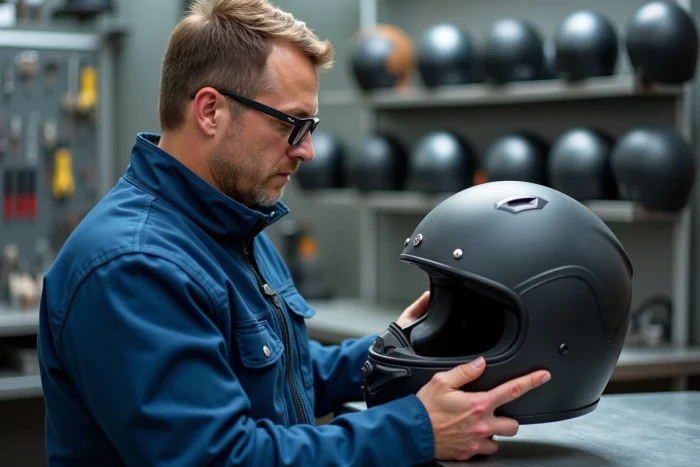
2011. The year when BMW motorcycle helmets changed their appearance without most riders noticing. The Bavarian brand, known for its high standards, has been outsourcing the manufacturing of its helmets to an external partner for over a decade. Gone is in-house production: design, engineering, assembly—everything is entrusted to a discreet specialist, chosen for its ability to apply exceptional technical criteria, quite different from those reserved for mere subcontractors. BMW has never hidden this strategy, but few know how distinctive, almost obsessive, the specifications are, in order to achieve a level of safety and comfort that leaves little room for chance.
Who are the experts behind the manufacturing of BMW motorcycle helmets?
The general public never names those who, far from the bright stands of trade shows, design each BMW motorcycle helmet. Here, a close-knit team of specialized engineers, designers passionate about riding ergonomics, and workshop technicians come together. These talents, united under the BMW Motorrad banner, have a clear mission: to exceed standards, anticipate expectations rather than just chain production.
The diversity of the BMW Motorrad range impresses with its ability to cover all uses. From the adventurous GS Carbon Trophy to the modular System 8 Carbon, not to mention the vintage Bowler Option 719 or the sleek Race Circuit, each helmet is born from a demanding collaboration between the parent company and its carefully selected industrial partners. Every step, from the first sketch to track testing, reflects a commitment to meet the needs of riders, whether they are traveling long distances or seeking performance on the track.
Behind every technical evolution, these professionals do not just assemble parts: they are involved from the selection of composites, in the development of new ventilation systems, and strive to make each model compatible with the latest in connected experience. Anyone wanting to explore behind the scenes or verify the robustness of the brand’s requirements will find all the answers here: everything you need to know about BMW motorcycle helmets.
Diving into the behind-the-scenes: materials, technologies, and design processes
In the factories where the helmets are developed, the pursuit of performance makes no compromises. The GS Carbon Trophy is a perfect example: its carbon fiber shell ensures both lightness and strength, a sought-after combo for enduro and off-road adventure enthusiasts. For the System 7 Carbon Option 719, the work on carbon is coupled with an obsession for aerodynamics.
The System 7 Carbon Evo and System 8 Carbon models take it a step further by integrating the MIPS or MIPS Integra TX system. This technology helps mitigate rotational forces during certain impacts. Add to this a multi-density EPS shell, sometimes structured like a honeycomb, and each impact sees its energy dissipated according to a logic of maximum safety. On the ConnectedRide Com P1 System 8, modernity goes further: embedded electronics, communication devices, and navigation, all cleverly integrated so that safety never becomes secondary.
To better grasp the diversity and specialization of the materials used in manufacturing:
- The shell combines carbon, glass, and sometimes aramid for a balance between lightness and robustness.
- The cushioning zones and finishes use polyurethane, polyester, or polycarbonate to meet technical requirements and comfort.
- Some interiors, like on the Bowler Option 719, benefit from a cowhide covering for a premium feel.
Nothing is left to chance. From custom ventilation to removable padding, each element undergoes meticulous checks, always under the watchful eye of the BMW Motorrad teams. The goal: to ensure an experience that does not compromise on aesthetics or safety.

Innovation and safety: how BMW pushes the limits of motorcycle helmets
In the testing rooms, the brand imposes a rigor seldom seen elsewhere. Each new feature aims to break the routine: on the System 8 Carbon, for example, the MIPS Integra TX protects the head from rotational energies in the event of an accident, reducing the risk of head trauma.
The motorcycle helmet certification evolves with the ECE 22.06 standard, which raises the bar. BMW doubles down: its flagship helmets also comply with SNELL certification and DOT standard. The result: a range ready to hit the road worldwide, while reassuring on the technical reliability of the product.
The service goes beyond just the shell. The ConnectedRide Com P1 System 8 opens a new chapter: motorcycle-to-motorcycle communication, GPS instructions in the earpiece, automatic emergency calling. All this, without compromising on safety. And to complete the setup, BMW installs reflective strips on its helmets, mandated by legislation in some countries, to maximize nighttime visibility.
Thinking long-term also means prioritizing fit, airflow management, weight control, and regular maintenance to prolong the helmet’s effectiveness. At every step, from technical planning to factory output, the brand’s strength is measured by the consistency of its requirements.
Riding under the BMW banner, every motorcyclist carries with them the promise of cutting-edge safety and innovations ready to meet tomorrow’s challenges. On the road, all these details, often invisible, become a guarantee of trust, with every turn taken and every kilometer covered.