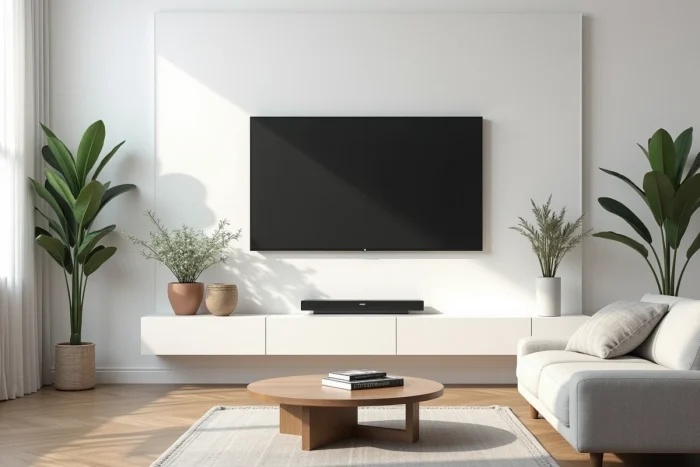
A mirror placed opposite a television screen creates a permanent source of direct reflection. Before deciding on the layout of a living room or bedroom, we recommend analyzing the optical interaction between the reflective surface and the type of panel used, as the result varies significantly depending on the type of television.
Specular Reflection and Panel Type: The Parameter That Decoration Ignores
A mirror reflects the light emitted by the screen, but also any light source present in the room. This phenomenon of specular reflection produces ghost images visible from the sofa, superimposed on the displayed content.
OLED panels, which typically have a surface treated with an anti-reflective filter, partially mitigate this issue. VA or glossy IPS panels, on the other hand, capture and reflect more ambient light. A mirror opposite amplifies this flaw by reflecting back to the screen the light it emits, creating a loop of unwanted reflection.
We observe that the perceived image quality drops significantly in rooms where a large wall mirror faces a glossy panel television. The perceived contrast decreases and blacks lose their depth, which particularly degrades the rendering in cinema viewing conditions, with dimmed lights.
This phenomenon is even more pronounced when the distance between the mirror and the screen is small. In a narrow room, the reflection bounces at short range and remains within the viewer’s field of vision. As detailed in the question of mirror placement in front of the television according to L’Atelier du Bricolage, unwanted reflections are the primary drawback reported by users facing this configuration.
Eye Strain in Front of the Screen: The Mirror as an Aggravating Factor
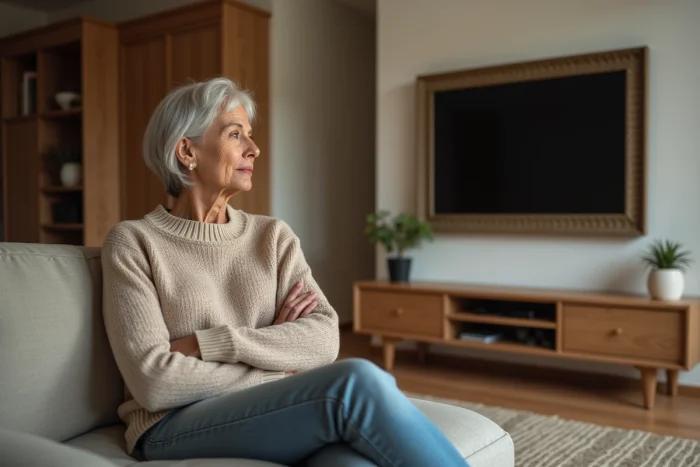
Visual ergonomics recommendations emphasize reducing sources of reflected light in the field of vision during prolonged screen use. A mirror positioned opposite the television acts as a permanent additional reflector.
The mechanism is simple: the eye must constantly manage two competing light planes (the image on the screen and its reflection in the mirror). This dual stimulus places unusual demands on accommodation and ocular convergence.
- Reflections in the mirror add a source of stray brightness that the eye tries to filter, increasing visual fatigue by the end of the day
- In the evening with artificial lighting, the mirror also reflects light from lamps, creating additional bright spots in the peripheral field
- The phenomenon worsens in a bedroom where viewing often occurs in a semi-reclined position, making the angle of view towards the mirror more direct
People wearing corrective lenses or contact lenses are more sensitive to these effects, as the anti-reflective treatments on their lenses do not compensate for a reflective source as large as a wall mirror.
Mirror Facing the Television: Cases Where It Works Anyway
The main argument in favor of this arrangement remains the gain in brightness and the feeling of space in small rooms. A large mirror visually enlarges a cramped living room or a bedroom without a side window.
This configuration can work under specific conditions:
- The mirror is positioned high enough on the wall so that the angle of reflection does not directly send the image of the screen back to the seated viewer
- The room has indirect lighting (LED strip in the ceiling, wall sconces directed towards the wall) that limits the bright spots captured by the mirror
- The television uses a matte or semi-matte panel with an anti-reflective treatment, reducing the amount of light reflected back to the reflective surface
- The distance between the mirror and the screen exceeds several meters, which mitigates the sharpness of the unwanted reflection
In a north-facing living room, where natural light remains diffuse, a mirror facing the television poses fewer problems than in a south-facing room with direct sunlight.
Alternatives to a Fixed Mirror Facing the Television
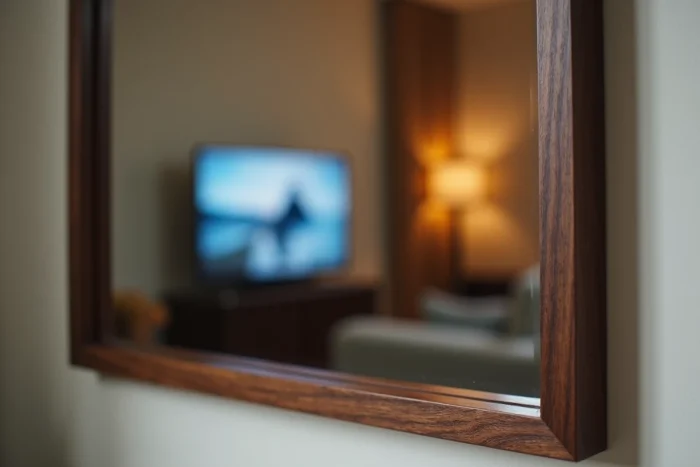
Reversible solutions are gaining ground. Rather than a fixed mirror directly opposite the screen, a tiltable mirror or one placed on a side wall offers the same decorative effect without creating permanent reflection towards the panel.
Mirror on a Perpendicular Wall
Placing the mirror on an adjacent wall (at 90 degrees to the television) maintains the contribution of visual depth and light. The angle of reflection no longer captures the image of the screen, and the viewer perceives no unwanted reflections from their usual position.
Tiltable or Pivoting Mirror
An articulated wall mount allows the mirror to be oriented according to use. During the day, the surface faces the room to maximize light. While watching, it can be tilted slightly towards the ceiling to redirect reflections out of the field of vision. This type of mount is available in heavy-duty wall mounting ranges for frames.
Non-Reflective Decorative Panels
For those looking to dress the wall opposite the television without creating reflection, panels made of matte materials (textured wood, stretched fabric, reconstituted stone) absorb light instead of reflecting it. The visual rendering on the screen is preserved, especially for cinema enthusiasts who carefully calibrate their image.
The choice primarily depends on the optical configuration of the room, not just on decorative taste. A mirror facing a television is not prohibitive in all cases, but it requires checking the angle of reflection, the type of panel, and the distance between the two surfaces. When these parameters work against visual comfort, side or tiltable alternatives solve the problem without sacrificing the room’s aesthetics.