Building a personal style is less about following seasonal trends than about identifying durable pieces that suit your shape and work well together. Second-hand shopping is an underused resource: it can attract new types of buyers by offering access to fabrics and finishes that cost more when bought new, while expanding your style options beyond what retailers offer in any given season.
Second-hand fashion and everyday style: check the condition, fabric and care costs
Starting with a vintage or pre-owned piece to define your look calls for a careful inspection. The cut alone is not enough: the fabric determines how long a garment lasts and how it drapes.
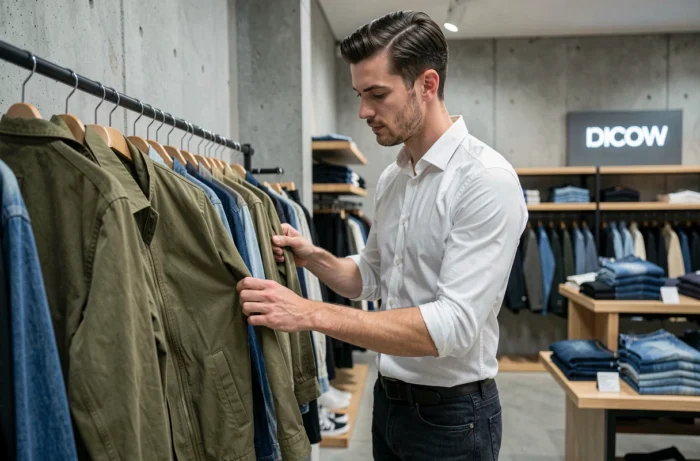
When browsing a thrift store for a wool coat, check the fabric thickness around the elbows and armholes. Localized thinning indicates structural wear that ironing will not fix. For a pre-owned raw denim pair of jeans, check how firm the fabric is around the crotch: denim that has already softened there will not last more than a season.
Care costs are a factor most guides overlook. A linen-blend blazer found at a low price second-hand may require regular dry cleaning, which can cost more than the original purchase price over the course of a year. By contrast, a superwash merino sweater can be machine-washed in cold water without losing its shape.
- Check the composition label before trying anything on: a high percentage of synthetic fibers in an older garment often indicates significant pilling
- Test the seams by gently pulling the sides apart—a seam that gaps under slight tension cannot be repaired cheaply
- Estimate the annual care budget (washing, dry cleaning, mending) for each piece before adding it to your wardrobe
Second-hand shopping gives you access to distinctive pieces no longer available in current collections. We find that shoppers who build their style around three to four standout second-hand pieces paired with new basics end up with a more cohesive wardrobe than those who keep accumulating seasonal new arrivals.
To find on-trend pieces and versatile basics, platforms such as Vêtement Mode let you compare cuts and fabrics before rounding out your selection.
Colors and combinations: narrow your palette for a more cohesive look
A wardrobe of no more than five colors works better than a rainbow closet. The principle is practical: every color you add increases the number of possible combinations, but also the chances of a mismatch.
Choose two neutrals (black, navy, heather gray, beige, off-white) and two or three accent colors. Accents do not have to be bright: deep burgundy, olive green or teal can fill this role without making outfits difficult to coordinate.
A common mistake is buying a trendy piece in a color that has nothing else to go with it. Terracotta trousers worn once in ten because they do not match anything in your closet are a wasted purchase, whatever the price. Before buying a garment, ask yourself: how many tops (or bottoms) already in my wardrobe can I pair with this to make a complete outfit? If the answer is fewer than three, move on.
The two-minute outfit test
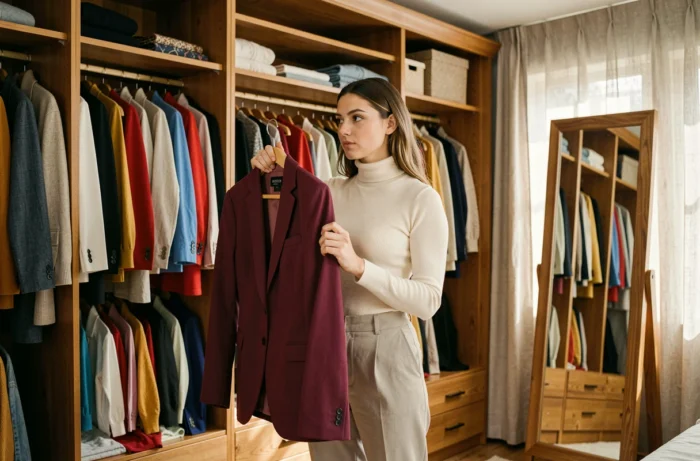
Hang your clothes by color, not by category. This visual arrangement immediately reveals duplicates and odd ones out. Too many black tops and just one pair of beige trousers point to an imbalance: without alternatives, you will keep wearing the same combination.
Accessories (belts, bags, shoes) count toward your palette. A bright red bag needs at least two neutral outfits to avoid overwhelming your look. An accessory in one of your neutral shades, on the other hand, goes with everything.
Choose clothes that suit your body shape without falling for clichés
Body-shape categories (A, V, H, O, X) are guidelines, not absolute rules. Freedom of movement matters more than theoretical classifications. A garment that restricts your shoulders or squeezes your waist will be abandoned within weeks, no matter how well it fits the recommendations for your body shape.
Focus on two measurable factors:
- Shoulder line: a blazer with a seam that falls more than a centimeter beyond the shoulder bone creates a drooping effect that can make your silhouette look heavier, unless you are deliberately going for an oversized style
- Waist ease: slide two fingers between the fabric and your skin. Less than one finger’s width means the garment is too tight for comfortable everyday wear. More than three fingers’ width and it hangs loosely, losing its shape
- Hem length on trousers or a dress: a hem that drags on the ground will wear out within months, while one that is too short alters your proportions—aim for the ankle on straight-leg trousers and at or just below the knee on a day dress
Sustainable fashion and environmental labeling: what is actually available today
The environmental impact of clothing is now covered by a French framework, but environmental labeling remains voluntary. There is still no legal requirement for brands to display an environmental score on the label.
In practice, this means buyers are responsible for checking the composition, origin and care instructions. Read the inside label: a garment with no composition details, or simply labeled “textile,” is a warning sign about the quality of the fibers used.
Cost per wear: the real measure of value
Dividing the purchase price by the estimated number of wears gives you a more accurate picture than the price tag alone. A low-cost basic T-shirt worn ten times before losing its shape costs more per wear than a heavyweight cotton piece that costs twice as much but is worn fifty times. This simple calculation changes how you choose between two seemingly comparable items.
Building an everyday style comes down to three recurring trade-offs: fabric quality over a new cut, compatibility with what you already own over an isolated impulse buy, and the true cost of use over the price on the rack. These criteria work just as well in a new-clothing store as they do when shopping second-hand.