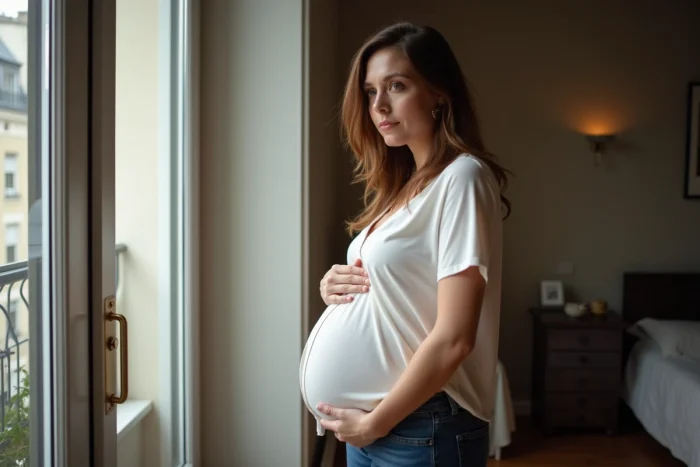
The numbers don’t lie: in France, the media sphere rarely grants a truce to public figures, who are subjected to a continuous flow of information and speculation. Social media accelerates the circulation of rumors, blurring the line between private life and public exposure.
For Anne Saurat-Dubois, the past few months have been marked by a surge of comments and questions regarding her personal situation. Reactions range from curiosity and a wait for confirmation to indifference, highlighting the difficulty in distinguishing verified information from ambient noise.
The rumor of a pregnancy: why is Anne Saurat-Dubois at the center of all attention?
The journalist pregnancy rumor slips into public debate at the slightest spark. A detail, a photo, or an unusual absence is enough to ignite the flames. Anne Saurat-Dubois, whose reputation as a political journalist is well established, thus finds herself in the turmoil of speculation. Her name enters digital conversations, sometimes lacking nuance, until it becomes a recurring question: Is Anne Saurat-Dubois pregnant? This inquiry, relayed and even dissected on social media, reflects the insatiable public appetite for the private lives of journalists and the magnifying effect that social platforms provide.
In the face of this curiosity, Anne Saurat-Dubois erects a firm barrier. She does not comment on anything personal, keeping her family life out of reach. This discretion, far from calming rumors, exacerbates them: silence becomes suspicious, each non-response turns into a hypothesis. Internet users, eager for certainties, concoct scenarios, fueling a debate without concrete elements.
In the blink of an eye, Anne Saurat-Dubois’s pregnancy has moved from the private sphere to become a public topic. Social media, true amplifiers, seize upon every detail—a different dress, a modified schedule, a prolonged absence—to build theories. This whirlwind exposes the thin line between information and speculation about the private lives of media personalities. Here, we touch on the obsession surrounding the intimate lives of female journalists, subjected to scrutiny that exceeds professional boundaries.
Between speculation and verified facts: untangling the true from the false around the information
When the journalist pregnancy rumor swells, the temptation to move faster than the facts is great. Yet, the profession demands method and discernment. Anne Saurat-Dubois, who studied at Sorbonne and CUEJ Strasbourg, has always claimed a clear line: her private life is her own business. The rumors about her family, circulating through tweets and anonymous messages, clash with a fundamental rule: French law guarantees protection of private life.
On social media, these safeguards rarely last long. A simple change in schedule, an absence, or an interpreted silhouette becomes fodder for speculation. On Twitter, comments multiply, often without the slightest proof. As for Instagram, it reveals nothing: Anne Saurat-Dubois’s account remains locked. On LinkedIn, only her professional engagements are visible, political interviews, including one with Jean-Luc Mélenchon, or the publication of “Profession: Lightning Rod.”
To clarify the situation, here’s what we know:
- Anne Saurat-Dubois strictly maintains confidentiality regarding her family.
- No official statement has confirmed the pregnancy rumor.
- The media coverage of the subject is based on assumptions rather than concrete elements.
The collective curiosity, fueled by virality and the lack of reliable information, constantly questions the balance between intimacy and media exposure. But ethics demand not to succumb to the ease of suspicion.

What this affair reveals about the media coverage of the private lives of female journalists
The media coverage of the private lives of female journalists reveals a persistent mechanism of surveillance and judgment. The example of Anne Saurat-Dubois speaks volumes: the private sphere of information professionals remains under the spotlight, while male discretion often goes unnoticed. In public debate, the mere prospect of motherhood becomes a topic, sometimes relegating competence to the background.
This unequal exposure insidiously fuels deep imbalances. The place of women in the media is scrutinized through the lens of suspicion and the debate on motherhood. The speculations surrounding “Anne Saurat-Dubois’s pregnancy” are not isolated: they illustrate the mechanisms of sexism and judgment about private life that persist in the profession.
Recent reports of sexual and moral harassment in newsrooms, highlighted by the Éric Monier cases or by the National Union of Journalists, confirm a heavy atmosphere. The vigilance of the Women’s Status Council or the CSST is not enough to dissipate social pressure. In this sector, gender equality faces the overexposure of the intimate, where family life sometimes becomes a professional issue. The transformation of Anne Saurat-Dubois’s pregnancy into a public rumor reminds us that the road remains long before competence prevails over curiosity.
Nothing indicates that the media storm is dying down. But one certainty remains: preserving the boundary between private life and public space has never seemed more necessary, nor more difficult, for those who make the news as much as they report it.